
Candlenut tree
Aleurites moluccanus · also called Candle nut, Candlenut tree, Varnish tree
The candlenut tree is a fast-growing rainforest tree with large, often lobed leaves and round fruit that hold hard, nut-like seeds. It is native to far north Queensland and South-East Asia rather than Brisbane, and in South East Queensland it has started spreading from plantings into bushland. The raw nuts act as a strong purgative and the heavy fruit drops, so place it with care.
- Australian native
- 10 to 15 m tall
- Flowers January to March
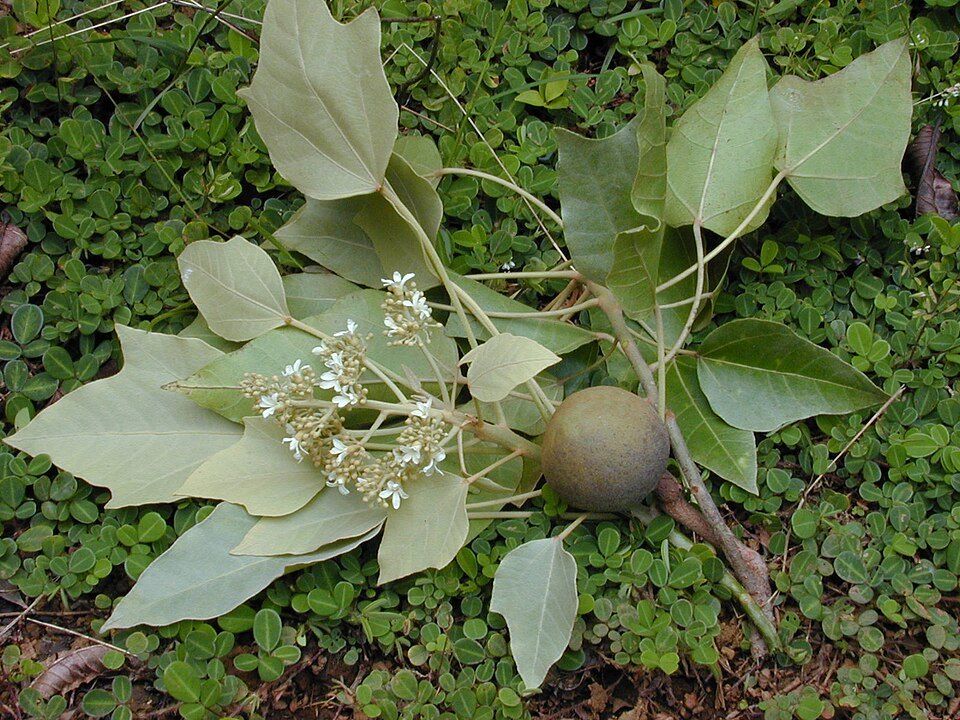
Candlenut at a glance
- Height
- 10 to 15 m (up to 30 m in the wild)
- Growth
- Fast
- Leaves
- Evergreen
- Flowers
- White, cream, January to March
- Origin
- Rainforests of far north Queensland, plus South-East Asia and the Pacific
- Family
- Euphorbiaceae
How to identify a candlenut
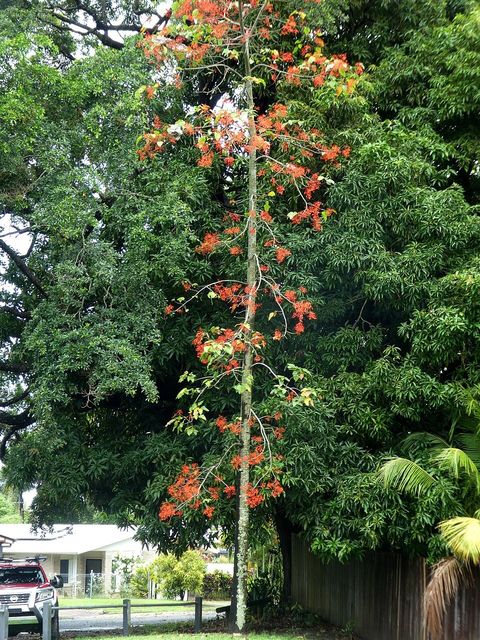
Candlenut is a large tree with fairly smooth grey or grey-brown bark. Its leaves are big, 7 to 24 cm long on long stalks, and may be plain or cut into three or five lobes. New shoots and young leaves are dusted with fine silvery or brownish star-shaped hairs. Small creamy white flowers open in large, branched clusters at the branch tips in summer, followed by round green fruit 4 to 6 cm across. A rarer native, Aleurites rockinghamensis, looks very similar but grows wild only in north Queensland, and young candlenuts can be mistaken for kurrajongs.
Growing a candlenut in Brisbane
Candlenut is often planted as an ornamental in coastal eastern Australia, but its natural home is the rainforest of far north Queensland. Around Brisbane it has escaped from cultivation: the Queensland Herbarium records it as naturalised in the Moreton district, and saplings have spread along Enoggera Creek at The Gap from a revegetation planting. It grows 10 to 15 metres tall, so it only suits large blocks, and it shouldn't be planted near creeks or bushland.
What to watch out for
Don't eat the nuts: CSIRO notes they are strongly purgative when raw and that the seeds of most Aleurites species contain poisonous compounds. The fruit is heavy and drops, leaving hard shells under the tree. Environmental Weeds of Australia describes candlenut as an emerging environmental weed in South East Queensland that shouldn't be planted near bushland, although it isn't on Brisbane City Council's weed list or Queensland's declared plant lists.
- Poisonous parts. The raw nuts are a strong purgative, and the seeds of most Aleurites species contain poisonous compounds, so don't eat them.
- Falling fruit. The heavy round fruit drops under the tree, and hard seed shells collect beneath large trees.
- Seedlings. Seedlings have escaped into Brisbane bushland, including saplings along Enoggera Creek at The Gap that spread from a revegetation planting.
Pruning and care
If you have a candlenut, formative pruning while it's young sets it up well: keep one strong leader and remove low, crossing or rubbing branches while they're small. Later, take out dead or damaged wood and keep limbs clear of roofs and paths. Rake up fallen fruit regularly, and pull up any seedlings while they're small so they don't establish. Large trees, or limbs over a house, are a job for a qualified arborist with the right gear.
Are candlenuts poisonous?
Is the candlenut tree native to Australia?
How big does a candlenut tree grow?

Sources and credits
- Aleurites moluccanus fact sheet Environmental Weeds of Australia (Lucidcentral)
- Aleurites moluccanus Australian Tropical Rainforest Plants, CSIRO
- Census of the Queensland Flora and Fungi 2025 Queensland Herbarium, Queensland Government
- Aleurites moluccanus (name record) Atlas of Living Australia
Photo: Forest & Kim Starr, CC BY 3.0, via Wikimedia Commons.
This profile updates sheet 20 of the plant profile booklet made for Colourful Tree Lopping in 2013. We checked every fact against current sources and rewrote it for the guide.
Checked October 2026. Weed listings and council rules change: check the council's and the Queensland Government's pages before you act.
Get a free quote. We'll beat most written quotes.
Tell us about the job and the site. You don't need to be home for the quote. Available 7 days.
- 4.9 on Google (38 reviews)
- Family owned & operating since 1993
- Fully insured
- We'll beat most written quotes