
Jacaranda tree
Jacaranda mimosifolia · also called Blue jacaranda, Jacaranda tree
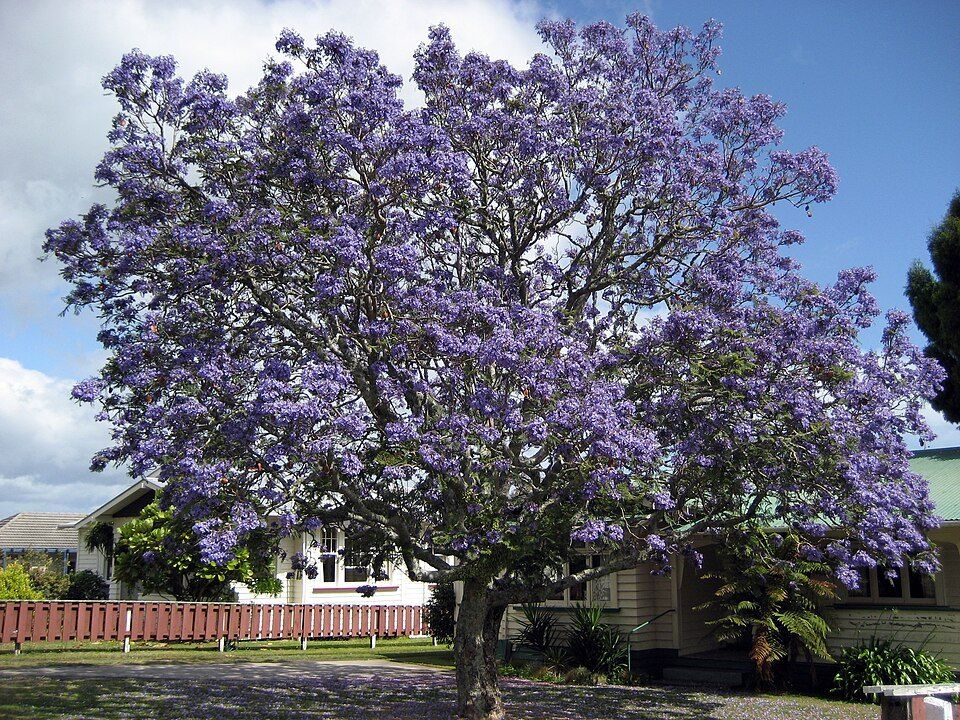
The jacaranda tree is the South American import behind Brisbane's purple spring, flowering from about mid-October into early November. It grows into a broad umbrella of fern-like leaves that casts light, dappled shade. It also spreads by seed into bushland and creek banks, so Brisbane City Council lists it as pest vegetation. Its roots and dropped flowers mean it needs plenty of room away from pipes, paths and pools.
- Exotic
- Brisbane pest plant
- 10 to 15 m tall
- Flowers October to November
Jacaranda at a glance
- Height
- 10 to 15 m (up to 20 m in the wild)
- Spread
- 10 to 15 m
- Growth
- Fast
- Leaves
- Deciduous
- Flowers
- Purple, blue, October to November
- Roots
- Aggressive
- Origin
- Bolivia and Argentina, South America
- Power lines
- Not on the council's list for under power lines
- Family
- Bignoniaceae
How to identify a jacaranda
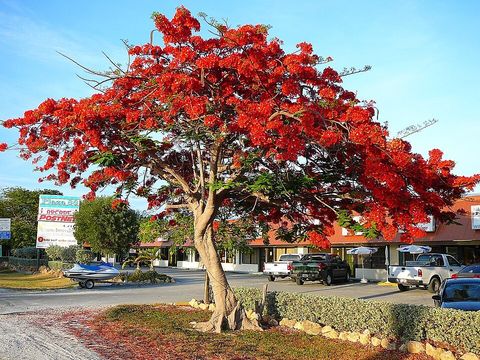
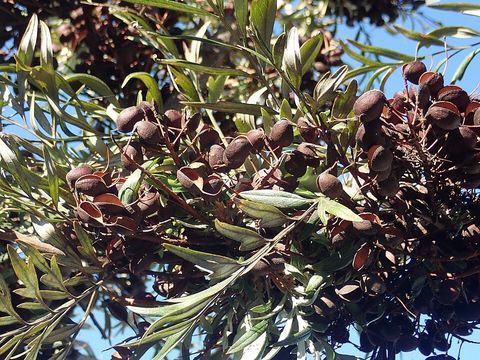
A spreading tree with an umbrella-shaped crown, usually 10 to 15 metres tall and about as wide. The leaves are soft and fern-like, up to about 33 cm long, with dozens of tiny pointed leaflets set in opposite pairs. In spring, loose clusters of tubular lilac-blue to purple flowers with a pale throat cover the canopy. Round, flat, woody pods up to about 8 cm across follow and split to release winged seeds. Young bark is smooth and turns finely scaly with age. Poinciana also has feathery leaves, but its flowers are red and come in summer. Tipuana, sometimes called yellow jacaranda, has yellow flowers.
Growing a jacaranda in Brisbane
Brisbane's jacarandas go back to 1864, when the species arrived at the City Botanic Gardens; that tree was probably the first grown in Australia. The warm climate suits it, and most trees bloom from about mid-October into early November. It wants full sun and well-drained soil. Council still plants it in some streets, though not under power lines or within a kilometre of environmentally sensitive areas. Seedlings escape into open woodland and along creeks, which is why Council also lists it as pest vegetation.
What to watch out for
Brisbane City Council lists jacaranda as pest vegetation because its seed sprouts easily and seedlings spread into bushland, often along creeks. The roots spread widely: Unitywater lists jacaranda among trees not to plant near water and sewer pipes, and roots can lift paths and fences in some soils. The wood is soft and brittle, so twigs and small branches snap in strong winds. Fallen flowers turn slippery when wet and clog pool filters, and dropped leaves can block gutters.
- Seedlings. Seed sprouts readily and can form thick clumps of seedlings under the tree that spread into bushland.
- Brittle branches. The wood is soft and brittle, so twigs and small branches can snap off in strong wind.
- Mess. Fallen flowers turn slippery when wet and clog pool filters, and shed leaves can block gutters.
Pruning and care
Jacarandas look best with little or no pruning. Cutting branches back makes the tree push up stiff vertical shoots that spoil its umbrella shape, and once that starts the only fix is to keep removing them. Limit work to dead, damaged or hazardous branches, and leave big limbs over the house or near power lines to a qualified arborist. Water young trees through dry summers, keep mulch no deeper than about 5 cm and spread it over moist soil, and pull out seedlings while they are small.
Jacaranda season in Brisbane
Jacaranda season in Brisbane runs from about mid-October into early November, a little earlier than Sydney, where the trees peak in November.
New Farm Park is the classic place to see them: Brisbane City Council's own page on the park lists its jacarandas alongside the rose gardens and poincianas. Visit Brisbane also sends people to Wilson Outlook Reserve in New Farm for the Story Bridge view, Coronation Drive at Toowong, Orleigh Park at West End, the City Botanic Gardens, Jacaranda Park at Yeronga and the University of Queensland at St Lucia, where the flowering lands in exam time and students call it 'purple panic'.
At home, the season brings a few jobs with it.
- The fallen flowers are soft and papery, and once rain hits them they turn slippery on paths, steps and driveways, so sweep paved areas while the tree is dropping.
- Flowers and the fine leaves collect in gutters and drains, and in the pool, where they can clog the filter.
- Seedlings come up thickly under the tree. Brisbane City Council lists jacaranda as pest vegetation, so pull them out while they are small.
- Dead, damaged or hazardous branches can come out at any time of year, but leave the live ones alone: cutting them back brings stiff upright shoots that spoil the umbrella shape.
When do jacarandas flower in Brisbane?
Is the jacaranda a weed in Brisbane?
Are jacaranda tree roots invasive?
Should I prune my jacaranda?

Sources and credits
- Jacaranda (weed identification tool) Brisbane City Council
- Frequently Asked Questions (weed identification tool) Brisbane City Council
- Street tree species (open data) Brisbane City Council
- Jacaranda mimosifolia fact sheet Environmental Weeds of Australia (Lucid key, Identic Pty Ltd)
- Jacaranda mimosifolia, New South Wales Flora Online PlantNET, Royal Botanic Gardens and Domain Trust
- Planting guide Unitywater
- Planting near sewer pipes Hunter Water
- Jacaranda Trees (gardening fact sheet) Burke's Backyard
- Why there's a lot more to love about jacarandas than just their purple flowers (Gregory Moore, The Conversation) ABC News
- Where to find the jacarandas in Brisbane Visit Brisbane
- Brisbane's first jacaranda Queensland Art Gallery | Gallery of Modern Art
- Jacaranda mimosifolia, Plants of South Eastern New South Wales Lucidcentral identification key
- Free Native Plants: Species (open data) Brisbane City Council
- Jacaranda mimosifolia species page Atlas of Living Australia
- New Farm Park vision project (New Farm Park page) Brisbane City Council
- Purple patch: where to find UQ's best locations for jacaranda photos (Contact magazine, October 2022) The University of Queensland
- Jacarandas (fact sheet) Flower Power
- Pruning advice (Dana Bolton, horticulturalist) Mr Fothergill's
- 6 essential rules of pruning Garden Clinic
Photo: Kahuroa, Public domain, via Wikimedia Commons.
This profile updates sheet 10 of the plant profile booklet made for Colourful Tree Lopping in 2013. We checked every fact against current sources and rewrote it for the guide.
Checked October 2026. Weed listings and council rules change: check the council's and the Queensland Government's pages before you act.
Get a free quote. We'll beat most written quotes.
Tell us about the job and the site. You don't need to be home for the quote. Available 7 days.
- 4.9 on Google (38 reviews)
- Family owned & operating since 1993
- Fully insured
- We'll beat most written quotes