
Small-leaved fig
Ficus obliqua · also called Small-leafed fig, Small leaf fig, Figwood
The small-leaved fig, also known as the small leaf fig, is a big native strangler fig from the rainforests of eastern Australia, including south-east Queensland. It builds a dense, wide crown over a massive buttressed trunk, and its small orange figs feed figbirds and other birds. It is far too large for most house blocks: Council plants it only in wide road medians, and water-seeking fig roots are a known risk to sewer pipes.
- Native to South East Queensland
- 10 to 20 m tall
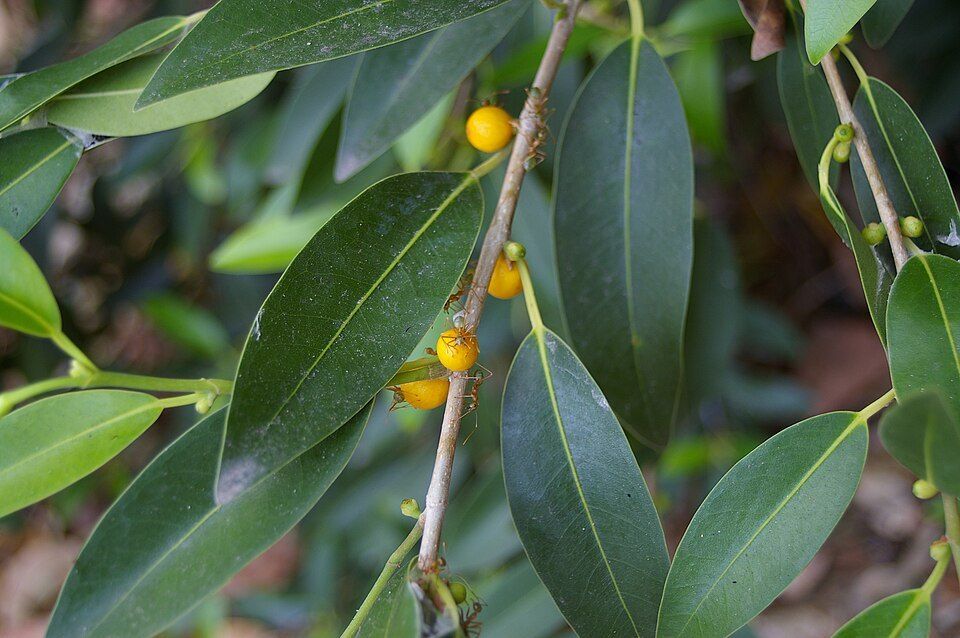
Small-leaved fig at a glance
- Height
- 10 to 20 m
- Leaves
- Evergreen
- Flowers
- Small and easy to miss
- Roots
- Aggressive
- Origin
- Rainforest from Cape York to southern New South Wales, plus Malesia and the south-west Pacific
- Power lines
- Not on the council's list for under power lines
- Family
- Moraceae
How to identify a small-leaved fig
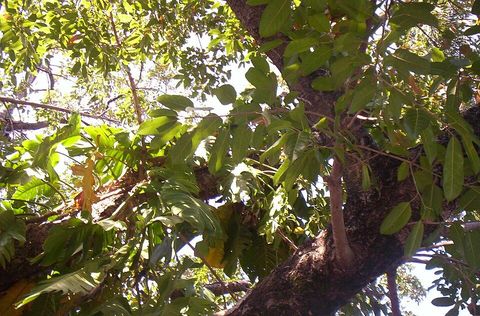
A large, spreading fig that often starts life on another tree and strangles it, ending up with a massive, buttressed trunk made of fused roots. The leaves are glossy dark green above and paler below, oval to oblong, mostly 5 to 12 cm long, on stalks 1 to 1.5 cm long. Broken twigs ooze plenty of sap. The figs grow in pairs, are round and 6 to 10 mm across, and ripen orange with dark red spots, mainly from April to June. The Moreton Bay fig has much bigger leaves, 10 to 25 cm long with rusty undersides, and the rusty fig's leaves are hairy and rust-coloured beneath.
Growing a small-leaved fig in Brisbane
The small-leaved fig grows naturally in rainforest from Cape York to southern New South Wales, including south-east Queensland, so it is at home in Brisbane's climate. That is also the problem: it becomes a very big tree with a very wide crown. Brisbane City Council uses it only on arterial road medians and roundabouts where the verge is wider than 5 metres, and never under power lines. In a home garden it belongs only on acreage, well clear of the house, pipes, paving and driveways.
What to watch out for
Size and roots are the main issues. The small-leaved fig grows into a huge, spreading tree with a buttressed trunk, and Council rates its crown as very large. Fig roots go looking for water: Hunter Water gives figs its highest (extreme) damage rating for sewer pipes, Urban Utilities advises against planting figs near sewers, and a Gold Coast council guideline warns that fig roots are highly invasive near buildings and underground services. Urban Utilities' general rule is to plant trees at least 3 metres from sewer pipes; a tree this big needs far more room.
- Size. Council rates its crown as very large and plants it only where verges are wider than 5 metres, and PlantNET describes a massive, buttressed trunk.
Pruning and care
Choose a spot where it can reach full size, so it never needs heavy cutting back. Formative pruning while the tree is young, taking out crossing branches and lifting low limbs, sets up a sound framework. Cut stems bleed a lot of sticky sap, so wear gloves. Get an arborist's advice before cutting any large roots, especially near paths or buildings. Work on big limbs and mature figs is a job for a qualified arborist with the right gear.
Are small-leaved fig roots invasive?
How big does a small-leaved fig grow?
Is the small leaf fig native to Brisbane?
Do birds eat small-leaved figs?
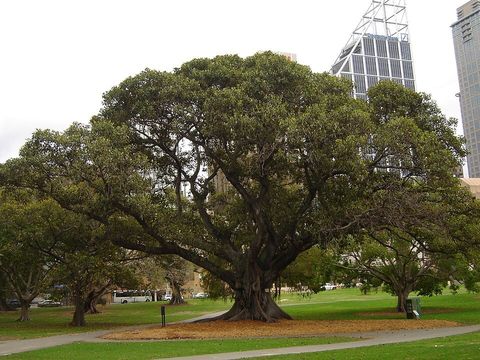
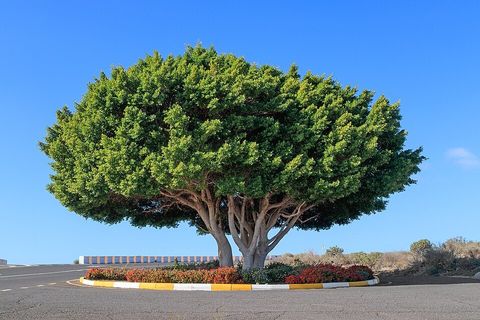
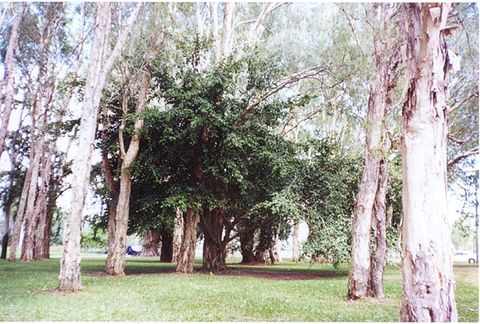

Sources and credits
- Street tree species (open data) Brisbane City Council
- Ficus obliqua (New South Wales Flora Online) PlantNET, Royal Botanic Gardens and Domain Trust
- Ficus obliqua (Australian Tropical Rainforest Plants) CSIRO
- Ficus obliqua, Small-leaved Fig (plant details) Noosa's Native Plants (Noosa Parks Association)
- Planting near sewer pipes Hunter Water
- Ipswich green thumbs urged to beware of thirsty tree roots (quoting Urban Utilities) Ipswich First (Ipswich City Council)
- Landscape Strategy Information Sheet 1: Guidelines for Undesirable Plants (January 2002) Gold Coast City Council
- Ficus obliqua (WildNet taxon details) Queensland Government
- Ficus macrophylla (New South Wales Flora Online) PlantNET, Royal Botanic Gardens and Domain Trust
- Ficus rubiginosa (New South Wales Flora Online) PlantNET, Royal Botanic Gardens and Domain Trust
- Ficus obliqua species page Atlas of Living Australia
Photo: John Robert McPherson, CC BY-SA 4.0, via Wikimedia Commons.
This profile updates sheet 35 of the plant profile booklet made for Colourful Tree Lopping in 2013. We checked every fact against current sources and rewrote it for the guide.
Checked October 2026. Weed listings and council rules change: check the council's and the Queensland Government's pages before you act.
Get a free quote. We'll beat most written quotes.
Tell us about the job and the site. You don't need to be home for the quote. Available 7 days.
- 4.9 on Google (38 reviews)
- Family owned & operating since 1993
- Fully insured
- We'll beat most written quotes