
Forest red gum
Eucalyptus tereticornis · also called Queensland blue gum, Blue gum, Red irongum
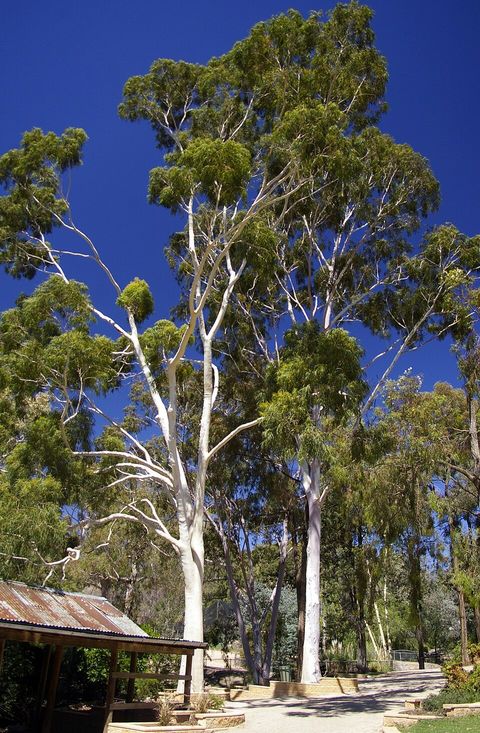
The forest red gum, known in Queensland as Queensland blue gum, is a tall local eucalypt with smooth bark patched in white, grey and blue. It is a primary koala food tree in South East Queensland, and it attracts birds and bees too. It grows fast and big, often 20 to 50 metres, so it suits parks, acreage and large lawns rather than small yards.
- Native to South East Queensland
- 20 to 50 m tall
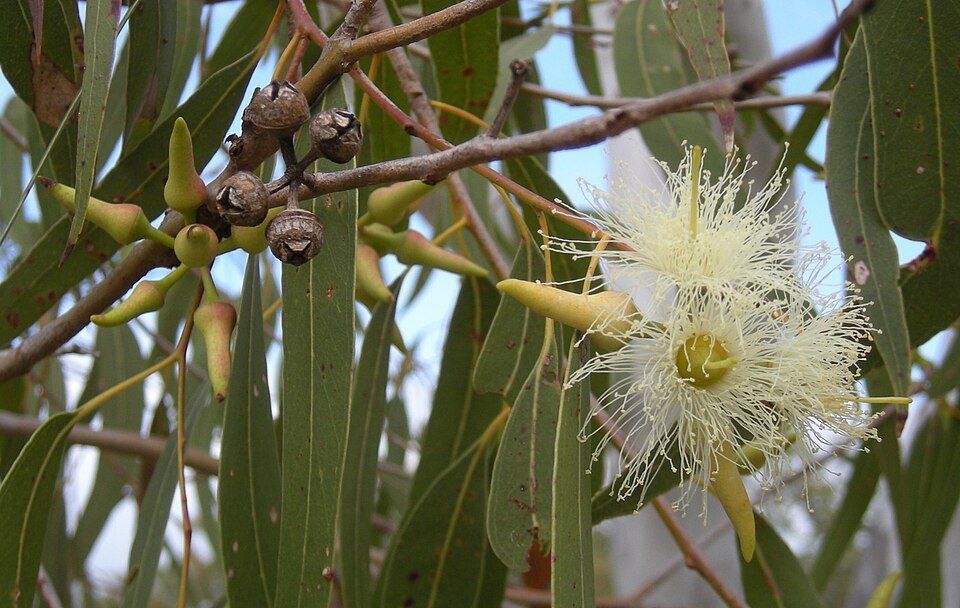
Forest red gum at a glance
- Height
- 20 to 50 m
- Growth
- Fast
- Leaves
- Evergreen
- Flowers
- White
- Roots
- Aggressive
- Origin
- Eastern Australia from eastern Victoria to far north Queensland, plus southern New Guinea
- Family
- Myrtaceae
How to identify a forest red gum
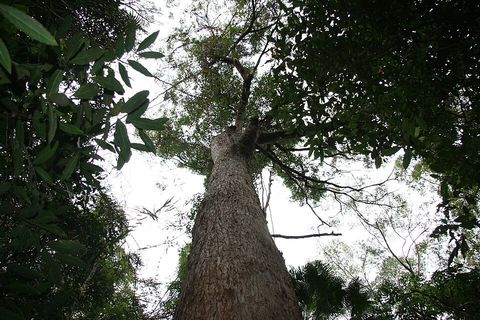
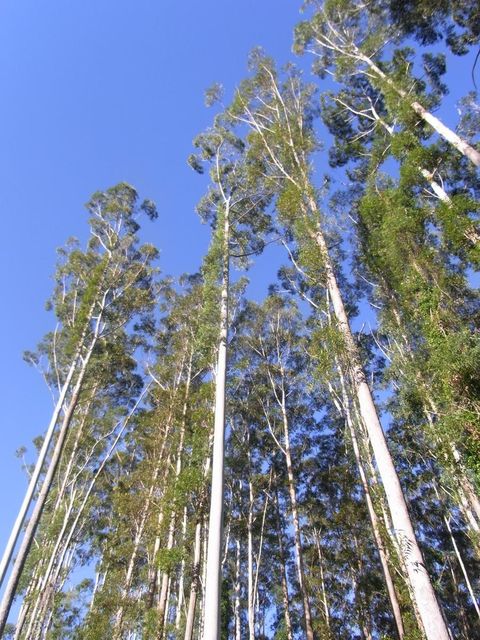
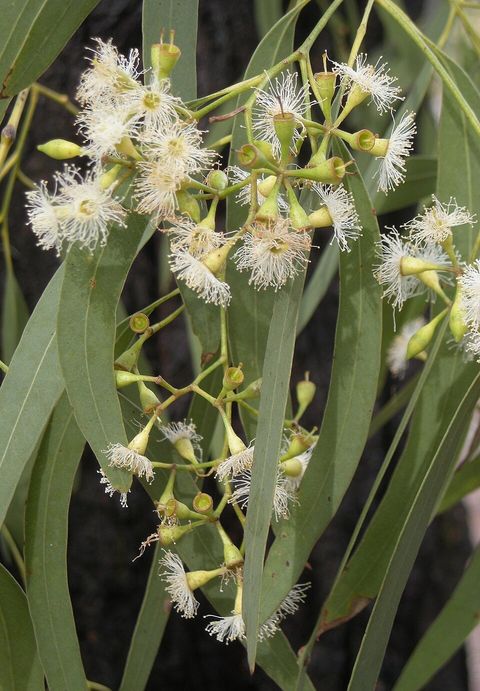
Look for a tall, straight trunk that sheds its bark in irregular sheets, leaving a smooth surface patched in white, grey and bluish tones, often with some dark, flaky bark at the base. The main limbs angle steeply upwards, more than in most gums. Adult leaves are long, narrow and often curved, and the same green on both sides. Buds grow in clusters of seven to eleven where the leaves join the stem, each with a long, horn-shaped cap that gives the species its name. The small gumnuts have valves that poke well out of the top.
Growing a forest red gum in Brisbane
Forest red gum is one of Brisbane's own trees. It grows naturally across South East Queensland, mostly on fertile flats and heavier clay or alluvial soils, and Brisbane City Council includes it in its list of local koala food trees. It is sometimes planted in larger parks and along streets. Its size is the issue for home gardens: it commonly reaches 20 metres or more, so it needs a big block with plenty of clearance from the house, pipes and power lines. On acreage it gives koalas and birds a valuable food source.
What to watch out for
Size is the main issue. Forest red gums grow 20 to 50 metres tall with trunks up to 2 metres across, and the Australian Plants Society notes they are usually too big for residential gardens. Unitywater lists large gum trees among those not to plant near water and sewer pipes, and Hunter Water rates large gums as a very high risk for sewer damage. Large limbs over houses, driveways or play areas should be checked by an arborist, especially before storm season.
- Size. It grows 20 to 50 metres tall with a trunk up to 2 metres across, and is usually too big for residential gardens.
Pruning and care
Young trees establish well as long as they get enough water at the start. Plant them in an open, sunny spot with room to spread, such as a large lawn. Like other gums, they can be attacked by caterpillars, leaf-eating beetles, psyllids and borers, but healthy trees usually recover from an attack. Prune only to remove dead, damaged or crossing branches, cutting just outside the branch collar. Any work on a mature gum is a job for a qualified arborist with the right gear.
Is forest red gum a koala food tree?
How tall does a forest red gum grow?
Are forest red gum roots a problem for pipes?
Is Queensland blue gum the same as forest red gum?

Sources and credits
- Eucalyptus tereticornis subsp. tereticornis (EUCLID: Eucalypts of Australia) EUCLID, Centre for Australian National Biodiversity Research
- Eucalyptus tereticornis, New South Wales Flora Online PlantNET, Royal Botanic Gardens and Domain Trust
- Forest red gum (timber properties) Business Queensland (Queensland Government)
- Eucalyptus tereticornis Australian Plants Society NSW
- Koala conservation Brisbane City Council
- Koalas (Land for Wildlife note) Land for Wildlife South East Queensland
- Eucalyptus tereticornis (plant details) Noosa's Native Plants
- Think before you plant (smart planting) Unitywater
- Planting near sewer pipes Hunter Water
- Learn about eucalypts (EUCLID introduction) EUCLID, Centre for Australian National Biodiversity Research
- Eucalyptus tereticornis (Australian Tropical Rainforest Plants) CSIRO
Photo: Ethel Aardvark, CC BY 3.0, via Wikimedia Commons.
This profile updates sheet 53 of the plant profile booklet made for Colourful Tree Lopping in 2013. We checked every fact against current sources and rewrote it for the guide.
Checked October 2026. Weed listings and council rules change: check the council's and the Queensland Government's pages before you act.
Get a free quote. We'll beat most written quotes.
Tell us about the job and the site. You don't need to be home for the quote. Available 7 days.
- 4.9 on Google (38 reviews)
- Family owned & operating since 1993
- Fully insured
- We'll beat most written quotes