
Spotted gum
Corymbia citriodora
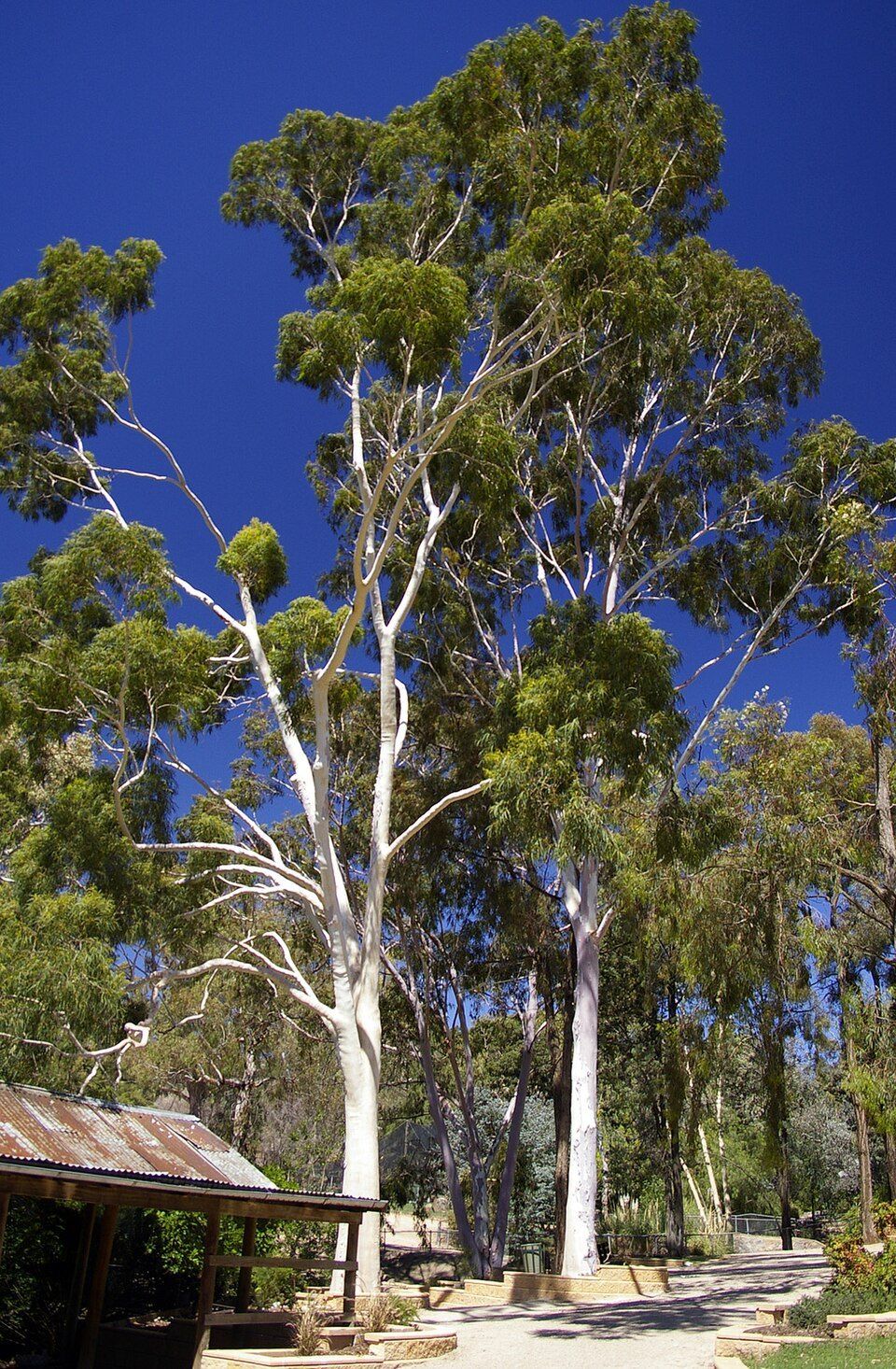
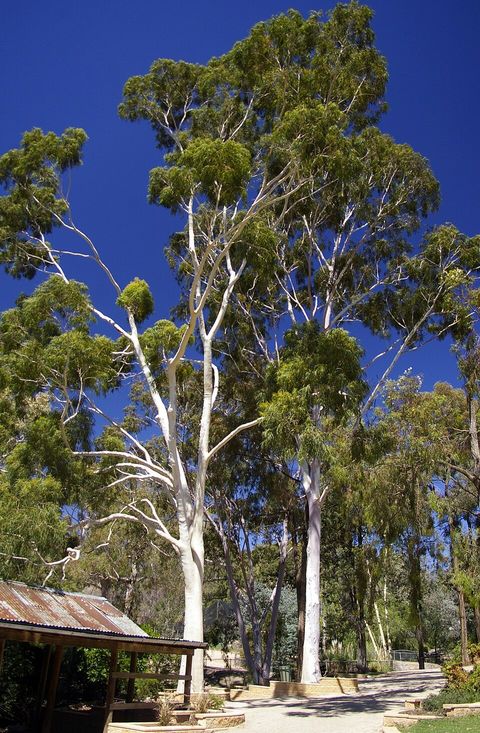
Spotted gum is a tall, straight eucalypt whose smooth bark sheds in patches, leaving a dappled cream, grey and pink trunk. It is native to the forests around Brisbane, where botanists now treat it as the unscented southern form of Corymbia citriodora, the lemon-scented gum's species. Queensland's timber industry harvests more of it than any other native hardwood. It is a fine tree for big blocks, but too large for most suburban yards.
- Native to South East Queensland
- 20 to 30 m tall
Spotted gum at a glance
- Height
- 20 to 30 m (up to 50 m in the wild)
- Leaves
- Evergreen
- Flowers
- Small and easy to miss
- Origin
- Northern NSW to about Maryborough, inland to Chinchilla and the Carnarvon Range
- Family
- Myrtaceae
How to identify a spotted gum
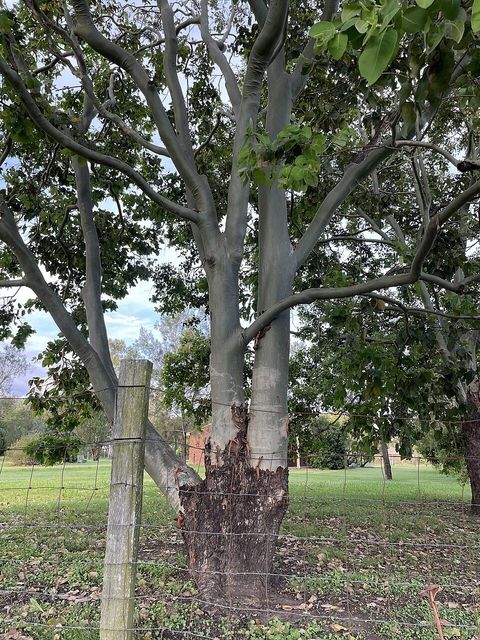
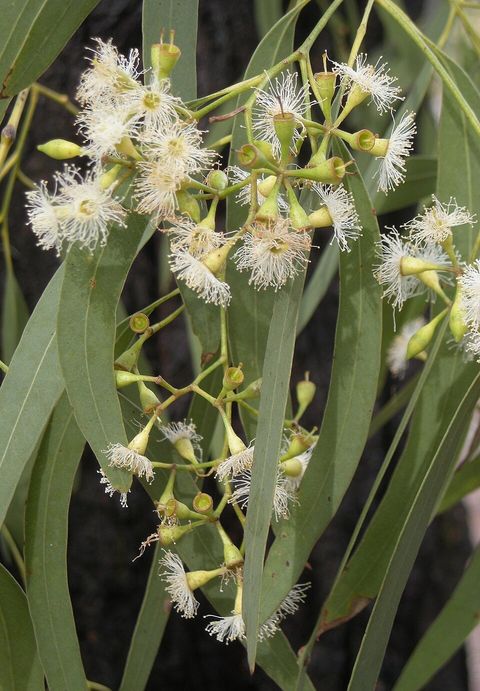
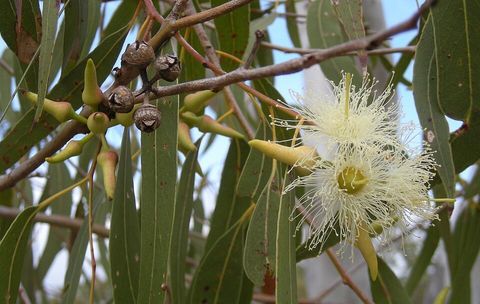
Spotted gum has a tall, straight trunk with smooth bark that comes away in patches, leaving a dappled pattern of cream, grey, blue-grey and pink. The crown is fairly open, with narrow, glossy, slightly curved leaves 10 to 23 cm long that have no lemon smell when crushed. That missing scent and the more strongly spotted trunk separate it from the lemon-scented gum. Small white flowers in clusters of three are followed by urn-shaped gumnuts about a centimetre wide. Brisbane's other spotted gum, Corymbia henryi, has broader leaves and bigger buds and gumnuts. The true Corymbia maculata grows only in NSW and the far east of Victoria.
Growing a spotted gum in Brisbane
Spotted gum is a local native of the dry forests and woodlands of South East Queensland, growing naturally from northern New South Wales to about Maryborough and inland to Chinchilla. It handles many soil types, tolerates dry spells and copes with only mild frost. It makes a handsome specimen on acreage, in parks and in large gardens, where its trunk can be seen in full. On a typical suburban block it soon becomes too big, and a mature tree beside a house deserves regular checks by an arborist.
What to watch out for
Size is the main issue: spotted gum grows into a tall tree of 20 to 30 metres or more, so it is too large for most suburban gardens and should be kept well clear of houses. It sheds bark in early summer, leaving lawns and paths untidy for a few weeks. It is not on Brisbane City Council's weed list.
- Size. It grows into a tall tree of 20 to 30 metres in cultivation and up to 50 metres in forest, too large for most suburban gardens.
- Mess. Like most smooth-barked gums it sheds bark in early summer, which can leave lawns and paths untidy for a few weeks.
Pruning and care
Spotted gum needs little care once established and copes well with dry spells. Prune only to remove dead, damaged or badly placed branches, cutting just outside the branch collar rather than leaving stubs. Its bark peels away in early summer, which is a normal part of its growth, so expect some raking for a few weeks. Young trees can be hit by a fungal shoot blight that damages new shoots and leaves. Large trees near buildings are a job for an arborist with the right gear.
Is spotted gum native to Brisbane?
Is spotted gum the same as lemon-scented gum?
How tall does a spotted gum grow?
Why is it called spotted gum?

Sources and credits
- Corymbia citriodora, EUCLID: Eucalypts of Australia Centre for Australian National Biodiversity Research (Lucid Central)
- Corymbia maculata, EUCLID: Eucalypts of Australia Centre for Australian National Biodiversity Research (Lucid Central)
- Corymbia henryi, EUCLID: Eucalypts of Australia Centre for Australian National Biodiversity Research (Lucid Central)
- Corymbia citriodora Flora of Australia (ABRS, via Atlas of Living Australia)
- Corymbia citriodora (accepted name and synonyms) Atlas of Living Australia
- Spotted gum (plantations) fact sheet Queensland Department of Agriculture, Fisheries and Forestry
- Corymbia maculata Australian Native Plants Society (Australia)
- Corymbia maculata Flora of Australia (ABRS, via Atlas of Living Australia)
- Corymbia citriodora, Growing Native Plants Australian National Botanic Gardens
Photo: Bidgee, CC BY 3.0, via Wikimedia Commons.
This profile updates sheet 44 of the plant profile booklet made for Colourful Tree Lopping in 2013. We checked every fact against current sources and rewrote it for the guide.
Checked October 2026. Weed listings and council rules change: check the council's and the Queensland Government's pages before you act.
Get a free quote. We'll beat most written quotes.
Tell us about the job and the site. You don't need to be home for the quote. Available 7 days.
- 4.9 on Google (38 reviews)
- Family owned & operating since 1993
- Fully insured
- We'll beat most written quotes